Interview transcript example: a worked sample and reusable layout
A worked interview transcript example in three common layouts, with every editorial decision explained, an anonymized version, and a template to download.
Try audio transcription free, in your browser →
An interview transcript identifies each speaker, separates turns into readable paragraphs, and gives the reader a way to find each passage in the recording — usually a timestamp at each turn. Below is one short, fictional interview shown three ways, followed by an explanation of every editorial choice, an anonymized version for sharing, and a layout you can copy. All names and dialogue are invented.
The example in three common layouts
Header used by all three:
Project: Neighbourhood gardens oral history · Interview ID: NG-04
Recording: community-garden-interview-01.m4a (unedited, 18:42)
Recorded: 2026-10-14, community hall
Style: clean verbatim · Time: elapsed from file start
Speakers: INTERVIEWER — project researcher; MAYA — garden volunteer
Layout 1 — timestamp and label on every turn (most common)
[00:00] INTERVIEWER: When did the north garden open?
[00:05] MAYA: We opened in—well, we started planting in April.
        The public opening was May 12.
[00:13] INTERVIEWER: Was that at the Harbor Street entrance?
[00:18] MAYA: Harper—sorry, Harbor Street. The sign had the old
        name for a week.
[00:26] INTERVIEWER: And what changed after the opening?
[00:31] MAYA: [pause] We added a Saturday shift, because neighbours
        asked for one. [laughs] We needed more volunteers fast.
Layout 2 — question and answer (journalism, Q&A articles)
Q: When did the north garden open?
A: We started planting in April. The public opening was May 12.

Q: Was that at the Harbor Street entrance?
A: Harbor Street. The sign had the old name for a week.

Q: And what changed after the opening?
A: We added a Saturday shift, because neighbours asked for one.
   We needed more volunteers fast.
Layout 3 — table (coding and analysis)
| Line | Time | Speaker | Text | Code / note |
|---|---|---|---|---|
| 1 | 00:00 | INTERVIEWER | When did the north garden open? | |
| 2 | 00:05 | MAYA | We opened in—well, we started planting in April. The public opening was May 12. | timeline |
| 3 | 00:13 | INTERVIEWER | Was that at the Harbor Street entrance? | |
| 4 | 00:18 | MAYA | Harper—sorry, Harbor Street. The sign had the old name for a week. | place name verified |
| 5 | 00:26 | INTERVIEWER | And what changed after the opening? | |
| 6 | 00:31 | MAYA | [pause] We added a Saturday shift, because neighbours asked for one. [laughs] We needed more volunteers fast. | demand; volunteering |
Layout 1 is the safe default. Layout 2 reads well in a publication but drops the timestamps, so keep Layout 1 as your source. Layout 3 suits qualitative analysis because line numbers and a coding column let you cite and tag passages, but it is tiring to read.
The times are illustrative and not aligned to a real recording. In a real transcript, take timestamps from the recording, not from a sample.
Every decision, explained
- “We opened in—well, we started planting in April.” In Layout 1 the self-correction is kept, because the speaker changes what she is claiming (planting started in April; the opening was later). In Layout 2, edited for reading, it is removed. That is the difference between clean verbatim and an edited copy.
- “Harper—sorry, Harbor Street.” The street name is corrected only because the speaker corrects herself on the recording. If the name had simply been uncertain, it would stay as heard with a note:
[unclear 00:18 — Harper/Harbor?]. Do not “fix” a name from context alone. - [pause] is included because the hesitation comes before an answer about a change, and the project’s style sheet says pauses are marked when they may matter. A general-purpose transcript would not mark every pause.
- [laughs] is kept because it changes how “We needed more volunteers fast” reads.
- Speaker labels:
INTERVIEWERis a role andMAYAa pseudonym. A real name never appears in a transcript that will be shared unless the participant agreed to it. - Questions are transcribed in full. Answers often only make sense next to the question, and the question shows whether the interviewer led the answer.
The anonymized version
For a shared or published research transcript, identifying details are replaced with neutral descriptions in square brackets, and the replacement is logged:
[00:13] INTERVIEWER: Was that at the [street name] entrance?
[00:18] P04: [Street name]. The sign had the old name for a week.
Keep the key that links P04 and [street name] to the real values in a separate, secured file, or destroy it if your ethics approval requires that. Check indirect identifiers too: a job title plus a small town can identify someone as surely as a name.
A layout you can copy
Project / interview ID:
Source filename and version:
Recording date:
Transcript style:
Time basis: elapsed from start / source timecode

Speaker key:
INTERVIEWER — [role or pseudonym]
PARTICIPANT — [role or pseudonym]

Notation: [unclear 00:00] unresolved speech · [overlap] simultaneous speech
          [pause] meaningful pause · [Note: …] transcriber's note

[00:00] SPEAKER: Spoken words here.
[00:14] SPEAKER: Next turn here.

Review ledger:
- 00:00 — issue — action — status
Or download the interview transcript template as a text file. The transcript template page has focus-group and meeting versions.
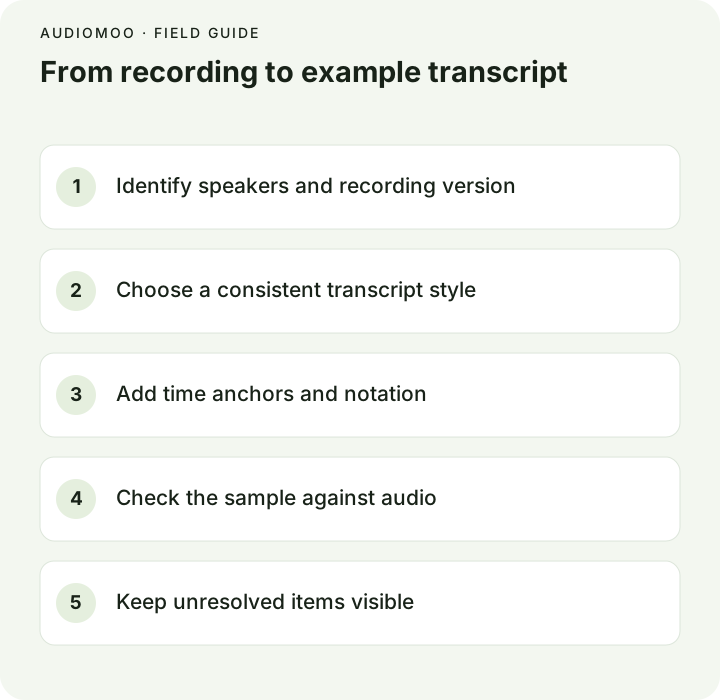
From recording to this layout
Make a draft with audio to text: it gives you timestamped paragraphs in your browser without uploading the recording. AudioMoo does not identify speakers, so add the labels yourself while listening — the paragraph breaks, which fall at pauses, are usually close to the turn changes. Then work through how to transcribe an interview for the full review process, and finish with the proofreading checklist.
Before sharing the transcript
Check every proper name and number against the recording or a permitted reference. Keep pseudonym keys separate, and make sure the file name does not reveal who was interviewed. Mark unresolved speech clearly instead of silently omitting it. The National Archives’ transcription tips make the same point for historical documents: transcribe what is there, and keep your own comments visibly separate from it.