What is verbatim transcription?
Verbatim transcription keeps the exact words spoken. Full verbatim vs clean verbatim vs edited, with the same passage in each, a style sheet to copy, and where each is required.
Try audio transcription free, in your browser →
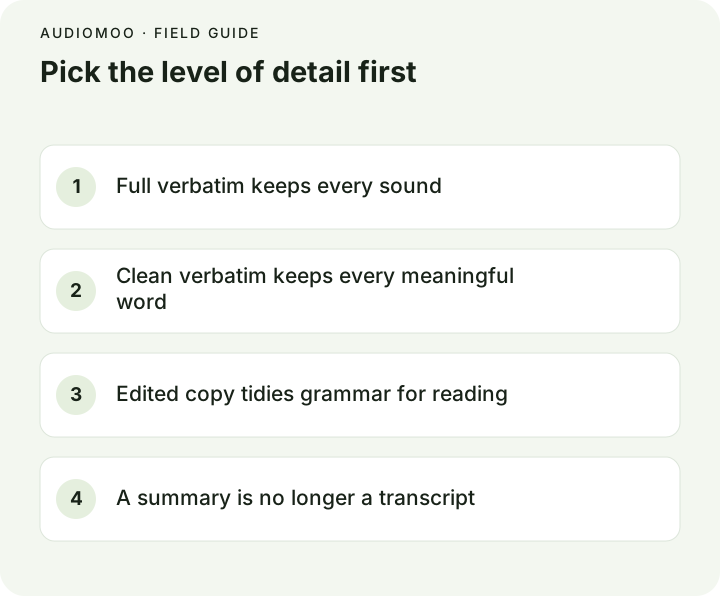
Verbatim transcription means writing down exactly what was said, word for word, without paraphrasing or correcting it. In practice the term covers two levels of detail: full verbatim (also called true or strict verbatim), which keeps every filler, false start, repetition and audible sound, and clean verbatim (also intelligent verbatim), which keeps every meaningful word but drops the “um”s and stutters. An edited transcript goes further and tidies grammar for reading. None of them is a summary.
One passage, four ways
The same invented answer from an interview:
| Style | What it looks like |
|---|---|
| Full verbatim | “Um, so I— I think we, we should’ve, like, left at nine? [laughs] But, uh, nobody wanted to.” |
| Clean verbatim | “I think we should’ve left at nine, but nobody wanted to.” |
| Edited | “I think we should have left at nine, but nobody wanted to.” |
| Summary (not a transcript) | The speaker thought the group should have left earlier. |
Look at what changes between rows. Clean verbatim removed fillers and a repetition but kept “I think”, because it signals uncertainty and is part of the meaning. The edited version expanded a contraction. The summary lost the speaker’s words entirely, which is why it must never be presented as a quotation.
What each style keeps
| Full verbatim | Clean verbatim | Edited | |
|---|---|---|---|
| Every meaningful word | ✓ | ✓ | ✓ |
| Fillers (um, uh, er, like, you know) | ✓ | — | — |
| False starts and self-corrections | ✓ | Only if they change meaning | — |
| Repetitions (“we, we”) | ✓ | — | — |
| Non-speech sounds ([laughs], [coughs]) | ✓ | Only if relevant | Rarely |
| Pauses | Marked, sometimes timed | Only if meaningful | — |
| Slang and non-standard grammar | ✓ as spoken | ✓ as spoken | Corrected |
| Contractions (“gonna”) | ✓ as spoken | Usually kept | Expanded |
Which one do you need?
- Court and legal proceedings: full verbatim, and usually by rule rather than choice. In US federal courts, for example, 28 U.S.C. § 753 requires proceedings to be recorded verbatim. Follow the court’s or firm’s own format.
- Conversation analysis and linguistics: full verbatim with a detailed notation for pauses (often timed, such as
(0.5)), overlaps and intonation. These conventions are specialised; use the one your field or supervisor specifies. - Qualitative research interviews: clean verbatim is the common default, unless hesitation is part of what you are studying. Decide with the research team and write it in the protocol.
- Journalism and quotations: clean verbatim for the transcript; anything put in quotation marks must match the recording.
- Podcasts, lectures, meetings, accessibility: clean verbatim or edited, whichever reads better for the audience. The W3C accessibility guidance on transcripts focuses on including the speech and the relevant sounds and visual information a reader would otherwise miss.
A style sheet to put at the top
Write the decision down so everyone who touches the transcript applies it the same way:
Style: clean verbatim
Fillers (um, uh, like): removed
False starts: kept only when the speaker corrects a fact
Repetitions: removed
Non-speech sounds: [laughs], [crosstalk], [phone rings] when they affect meaning
Pauses: [pause] only where the pause is part of the answer
Unclear speech: [unclear 00:12:08]
Spelling: US English; names per the project's spelling list
Numbers: as spoken for one to ten, digits above
What speech recognition gives you
A machine transcript is closer to clean verbatim than to full verbatim. Models like Whisper — the model behind AudioMoo’s on-device engine — were trained largely on audio paired with existing captions and transcripts, which are usually tidied, so they tend to drop fillers, smooth out false starts and add punctuation. That is convenient for a reading copy and a problem for full verbatim: hesitations that were spoken may simply be missing from the draft.
So if you need full verbatim, treat the machine draft as a starting point and listen for what was left out, especially at the start of answers, around corrections and in overlaps. If you need clean verbatim, the draft is often close, but check that the model has not “cleaned” something meaningful: a dropped “not”, a merged repetition that was really two different words, or a corrected word the speaker never said. The proofreading checklist is built for that pass.
Apply it in practice
- Make a draft with audio to text. It runs in your browser and does not upload the file.
- Keep an unchanged copy of the draft.
- Paste the style sheet into the header of a second copy, using the transcript template.
- Listen through once, applying the style. Mark what you cannot resolve with a timestamp instead of guessing.
- Read the result once without audio, looking for edits that changed certainty, negation, names or numbers.
Questions
Is verbatim the same as word for word? Yes, for the words themselves. The difference between full and clean verbatim is what happens to the sounds and disfluencies around the words.
Does verbatim include grammar mistakes? Yes. Both verbatim styles keep the speaker’s grammar as spoken. Correcting it turns the transcript into an edited one.
Is intelligent verbatim the same as clean verbatim? In most usage, yes. Some agencies use “intelligent” for a slightly more edited style, so check the definition when you order or deliver transcripts.