Word error rate (WER): formula, example and calculator
How word error rate is calculated, a worked example on a real machine transcript, why normalization changes the score, what WER cannot tell you, and a calculator.
Try audio transcription free, in your browser →
Word error rate (WER) is the standard measure of speech recognition accuracy: the share of words a machine transcript gets wrong compared with a checked human transcript, called the reference. It counts the smallest number of word edits that turn the machine output into the reference:
WER = (S + D + I) ÷ N × 100%
where S is substitutions (a wrong word), D deletions (a word that is missing), I insertions (an extra word), and N the number of words in the reference. Lower is better. A WER of 10% means roughly one edit for every ten reference words.
A small example
Reference: We planted three green trees today (6 words) Recognized: We planted two trees today
“three” → “two” is one substitution; “green” is missing, one deletion; nothing was added. WER = (1 + 1 + 0) ÷ 6 = 33.3%. Short texts swing wildly: one more error would make it 50%.
A worked example on a real machine transcript
Small invented sentences hide what errors look like in practice, so here is a real one. We ran a 45-second excerpt of a public-domain audiobook — 120 words from L. Frank Baum’s Oz series, taken from the LibriSpeech test corpus, which comes with a checked reference transcript — through AudioMoo’s free browser tool, with the language set to English. This is the beginning of what came back, unedited:
I begged Ruggadot along I go to send him away, but he would not do so. I also offered to help your brother to escape, but he would not go. He eats and sleeps very steadily, replied to Nooking. I hope he doesn’t work too hard since Shaggy. at all. […] Not exactly, we’ve turned Calico. Where is my brother now? In Quired Shaggy. In the Metal Forest. Where is that? The Metal Forest is in the Great Dome to Cavern, the largest in all our Dominions, Ripleyed Calico.
And here are all the differences from the reference, after normalizing both texts:
| Reference | Recognized | Counted as |
|---|---|---|
| ruggedo long ago | ruggadot along i go | 3 substitutions + 1 insertion |
| replied the new king | replied to nooking | 2 substitutions + 1 deletion |
| said shaggy he does not work at all | since shaggy at all | 1 substitution + 4 deletions |
| returned kaliko | we have turned calico | 2 substitutions + 2 insertions |
| inquired shaggy | in quired shaggy | 1 substitution + 1 insertion |
| great domed cavern | great dome to cavern | 1 substitution + 1 insertion |
| replied kaliko | ripleyed calico | 2 substitutions |
Totals: 12 substitutions, 5 deletions, 5 insertions over 120 reference words:
WER = (12 + 5 + 5) ÷ 120 = 18.3%
Three things this table shows better than the number does:
- Most errors are names. Ruggedo and Kaliko are invented names a general model has rarely heard, and “the new King” — a title, said quickly — became “to Nooking”. Everyday words were almost all right. Your own recordings will behave the same way with people’s names, product names and jargon.
- Errors cluster. One misheard name often costs two or three edits, because the model splits or merges words around it (“Ruggedo long ago” → “Ruggadot along I go”).
- One error matters more than the rest. Dropping “he does not work” removes a whole statement. A reader of the transcript would never know it was said. No percentage weights that differently from a misspelt name.
This is one short clip, not a benchmark: a single passage full of fantasy names says little about how any system performs on your recordings. It is here to show how the formula meets real output.
Normalization changes the score
Before counting, both texts must be brought to the same form, or formatting differences count as errors. In the example above, the machine wrote “we’ve” and the reference spells words in capitals without punctuation. Typical normalization steps:
- lowercase everything and remove punctuation;
- expand or standardize contractions (“we’ve” → “we have”);
- write numbers one way (“twenty one” vs “21”);
- standardize spellings and titles (“Mr.” → “mister”).
The Whisper paper (Radford et al., 2022) spends a section on this because naive comparisons penalized its fluent, punctuated output, and its authors published the normalizer they used. We used that English normalizer for the example above. The lesson for your own comparisons: use the same normalizer for every system you compare, and say which one you used. Two WER figures computed with different normalization are not comparable.
What WER cannot tell you
- Which errors matter. Every edit counts as one, whether it is “a” for “the” or the wrong drug dose.
- Punctuation, capitalization and paragraphs, which are usually normalized away even though they affect readability.
- Who spoke. Speaker errors are measured separately, with the diarization error rate.
- Your audio. A published WER on a public test set (clean read audiobooks, for example) is often far lower than what the same system scores on a noisy meeting room or a phone call.
WER can also exceed 100% when there are many insertions — it is an edit rate, not a percentage of correct words.
Calculate WER
Enter your own counts below. For anything beyond a few sentences, let an alignment tool count the edits — for example the open-source jiwer Python package — and inspect the alignment where it is ambiguous. The calculator does the arithmetic only.
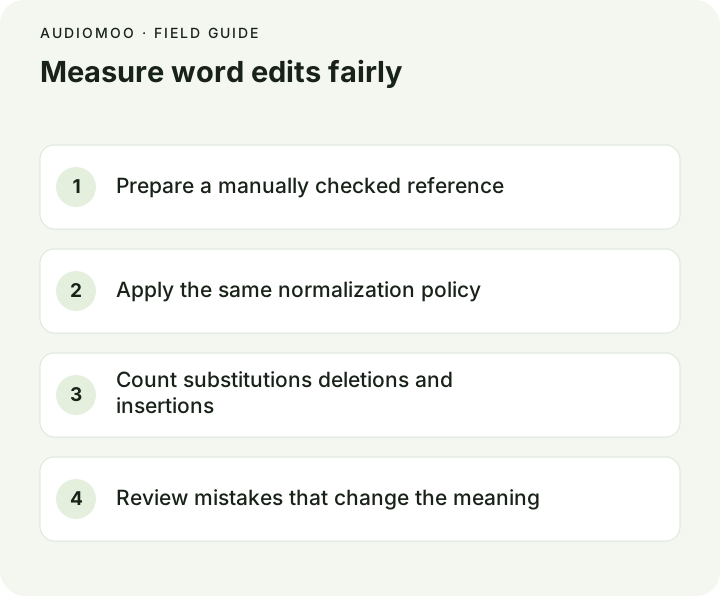
How to measure WER on your own recordings
- Pick two to five minutes of audio that is typical of your work: same microphones, rooms, accents and number of speakers.
- Produce a careful reference transcript by hand, and have a second person check it.
- Run each system you want to compare on the same file. For AudioMoo, audio to text runs in your browser without uploading the file.
- Normalize all texts the same way and compute WER with the same tool.
- Alongside the number, list the errors that would change meaning for your readers — names, numbers, negations, dropped phrases. That list usually decides more than the percentage.
Questions
What is a good word error rate? It depends entirely on the audio. On clean read speech, modern systems score in single digits; on overlapping conversation or noisy phone calls, scores several times higher are common. Compare systems on your own audio rather than against a general threshold.
Is word accuracy just 100% minus WER? Roughly, and only when there are few insertions. Because insertions are counted, “accuracy” derived this way can be misleading; report WER and its parts.
What is character error rate (CER)? The same formula over characters instead of words. It is used for languages written without spaces, such as Japanese and Chinese, where splitting text into words is itself ambiguous.
Calculate word error rate
Compare with a manually checked reference. Keep punctuation and number normalization consistent. WER measures word edits, not whether a mistake changes meaning.
(Substitutions + deletions + insertions) ÷ reference words × 100.